The Hidden Costs of Disposable Emails (And How Blocking Them Saves You Thousands)
8 MINUTES READ
From CRM contact-tier inflation to free-trial credit farming and burned domain reputation—here is the real cost of disposable emails and how a free temp email checker saves thousands.
When builders think about temporary or disposable email addresses, they usually view them as a minor product annoyance: "A few anonymous users testing the app or downloading a guide. No big deal, right?"
In reality, disposable emails are a silent drain on your company's balance sheet.
Every throwaway inbox that slips past your signup form creates a ripple effect of recurring SaaS fees, stolen compute credits, degraded sender reputation, and wasted engineering hours. If you run a SaaS, an e-commerce platform, or a newsletter, unvetted signups can quietly cost you hundreds to thousands of dollars every month.
Here is a financial breakdown of the true costs of disposable emails—and how putting a free temp email checker at the front door protects both your margins and your domain.
1. The "Zombie Contact Tax" on Marketing & CRM Platforms
Most marketing automation platforms and CRMs—including HubSpot, Mailchimp, Klaviyo, ActiveCampaign, and Loops—price their tiers based on audience size or total stored contacts.
Here is how the economics work against you:
- A visitor signs up with a 10-minute temporary inbox (
@mailinator.com,@guerrillamail.com, or@yopmail.com). - Your backend creates the contact record and syncs it to your CRM or marketing tool.
- Fifteen minutes later, the temporary mailbox ceases to exist.
- That contact sits in your CRM forever unless you manually audit and purge it.
When your contact list grows from 9,500 to 10,500 contacts because of 1,000 burner emails, you are automatically bumped to the next pricing tier:
You are literally paying a monthly subscription fee to store dead, unreachable inboxes. Filtering disposable domains at the registration step stops dead records from ever entering your CRM sync pipeline.
2. Preventing Free Trial and AI Credit Farming Abuse
If your product offers free trial credits, sign-up perks, or API allowances (such as $5 in free LLM tokens, 20 AI generations, or a $10 coupon code), disposable emails are an open invitation for exploit scripts.
Script-kiddies and bot operators use automated disposable email generators to cycle through thousands of accounts:
- They script automated signups using disposable domains.
- They consume the sign-up compute, AI tokens, or cloud bandwidth for free.
- Once credits run dry, they discard the email and trigger another signup.
1Without Validation:2Bot Script ──> Temp Email ──> Free Sign-Up ──> Burns $5 in AI API Credits ──> Discards Inbox3(Repeated 500x = $2,500 unrecoverable cloud/LLM bill)If 200 bot signups each consume $3 worth of OpenAI API tokens or GPU inference, that is $600 per month charged directly to your infrastructure credit card—with zero conversion chance.
Gating signups with a disposable detector immediately kills 95%+ of low-effort multi-accounting scripts without requiring heavy, high-friction CAPTCHAs for legitimate users.
3. The $15,000 Deliverability Death Spiral
The most catastrophic cost of disposable emails is not the storage—it is sender domain reputation.
Major mailbox providers (Google Workspace, Gmail, Microsoft 365, Yahoo) evaluate how recipients treat your mail. One of their most strictly enforced signals is hard bounce rate.
- Industry standard delivery targets keep hard bounces under 2%.
- Exceeding 5% triggers immediate scrutiny, spam foldering, or rate-limiting.
Because disposable inboxes are deleted minutes after creation, every automated email you send after signup—your welcome email, onboarding sequence, email verification link, or day-3 check-in—will hard bounce.
1High Disposable Signups2 │3 ▼4Elevated Hard Bounce Rate (>3-5%)5 │6 ▼7Domain Reputation Downgraded by Gmail & Microsoft8 │9 ▼10Legitimate Customer Emails Land in Spam Folder11 │12 ▼13Real Customers Miss Password Resets, Invoices & Onboarding14 │15 ▼16Direct Churn, Lost Revenue, & Costly RemediationWhat does recovering a burned domain cost?
When your transactional emails start landing in spam:
- Legitimate paying customers can't log in (missing 2FA and password reset tokens), driving up customer support tickets.
- Trial activation rates plummet because users never see the onboarding steps.
- Restoring a burned IP and domain requires hiring deliverability consultants, purchasing dedicated IPs, and executing a multi-month IP warming schedule—often costing $5,000 to $15,000+ in lost revenue and tooling.
Checking for disposable providers on signup keeps your hard bounce rate near zero, protecting the inbox placement of your revenue-generating emails.
4. Saving on Expensive Third-Party Verification SaaS
Many engineering teams realize they have a disposable email problem and immediately integrate a commercial verification API (such as ZeroBounce, NeverBounce, or Hunter).
While those platforms work, they are expensive when all you need is a fast check at registration:
- Commercial verification APIs typically charge $0.008 to $0.015 per check.
- If your application receives 25,000 signups or verification requests a month, you are paying $200 to $375/month ($2,400 to $4,500/year) just to know if a domain is a throwaway inbox.
Reloop provides the Temp Email Checker completely free of charge. You can call the public JSON API without any account registration or API keys:
1curl -X POST https://reloop.sh/api/tools/v1/temp-email-checker \2 -H "Content-Type: application/json" \3 -d '{"email": "test@mailinator.com"}'Response:
1{2 "domain": "mailinator.com",3 "verdict": "disposable",4 "isDisposable": true,5 "confidence": 0.99,6 "riskScore": 0.95,7 "signals": {8 "syntax": "pass",9 "disposable": "fail",10 "role": "pass",11 "freeProvider": "pass"12 }13}By substituting a costly verification SaaS with a specialized, continuously updated open-source catalogue of 210,000+ throwaway domains, you instantly pocket those savings.
5. Summary: What a Growing Startup Saves Every Month
Let's look at the financial picture for a modern SaaS receiving 5,000 monthly signups, where roughly 12% (~600 signups) are disposable addresses:
That represents $5,000 to $14,000+ in annual operational savings from a single validation check.
How to Implement in Your App in 60 Seconds
You don't need a bulky SDK or a paid subscription to protect your registration endpoints. Here is how you can gate user signups in a standard Next.js, Node.js, or Express backend:
1// app/api/signup/route.ts or similar backend registration handler2export async function POST(req: Request) {3  const { email, password } = await req.json();4
5  // 1. Call Reloop's public checker endpoint6  const checkRes = await fetch("https://reloop.sh/api/tools/v1/temp-email-checker", {7    method: "POST",8    headers: { "Content-Type": "application/json" },9    body: JSON.stringify({ email }),10  });11
12  const check = await checkRes.json();13
14  // 2. Reject disposable providers before writing to your database15  if (check.isDisposable) {16    return Response.json(17      { error: "Please use a permanent work or personal email address to sign up." },18      { status: 400 }19    );20  }21
22  // 3. Proceed with normal account creation & CRM sync23  // await db.user.create({ data: { email, ... } });24
25  return Response.json({ success: true });26}
Notice what happens:
- Malformed emails and disposable providers are rejected before any row is written to PostgreSQL.
- No welcome email is queued in BullMQ or your MTA, so no hard bounce ever happens.
- No ghost user is synced to HubSpot or Loops.
- No free compute or AI trial tokens are issued.
Complete Your Deliverability Pipeline
Stopping disposable emails at signup is the highest-ROI defensive move you can make for your infrastructure. But deliverability is multi-layered:
- Gate signups: Use the free Temp Email Checker or its public API on registration forms.
- Clean historical lists: If your database already has legacy contacts, run them through the free Email Validator to purge expired addresses and syntax errors before launching marketing campaigns.
- Verify DNS & Authentication: Ensure your SPF, DKIM, and DMARC records are strict so legitimate mail never gets blocked.
- Own your email infrastructure: If you are tired of opaque pricing and vendor lock-in from proprietary ESPs, explore Reloop—open-source email infrastructure built for developers who care about control, performance, and transparent costs.
Protect your signup pipeline today by testing a domain on the Free Temp Email Checker or integrating the endpoint directly into your auth flow.
Read more
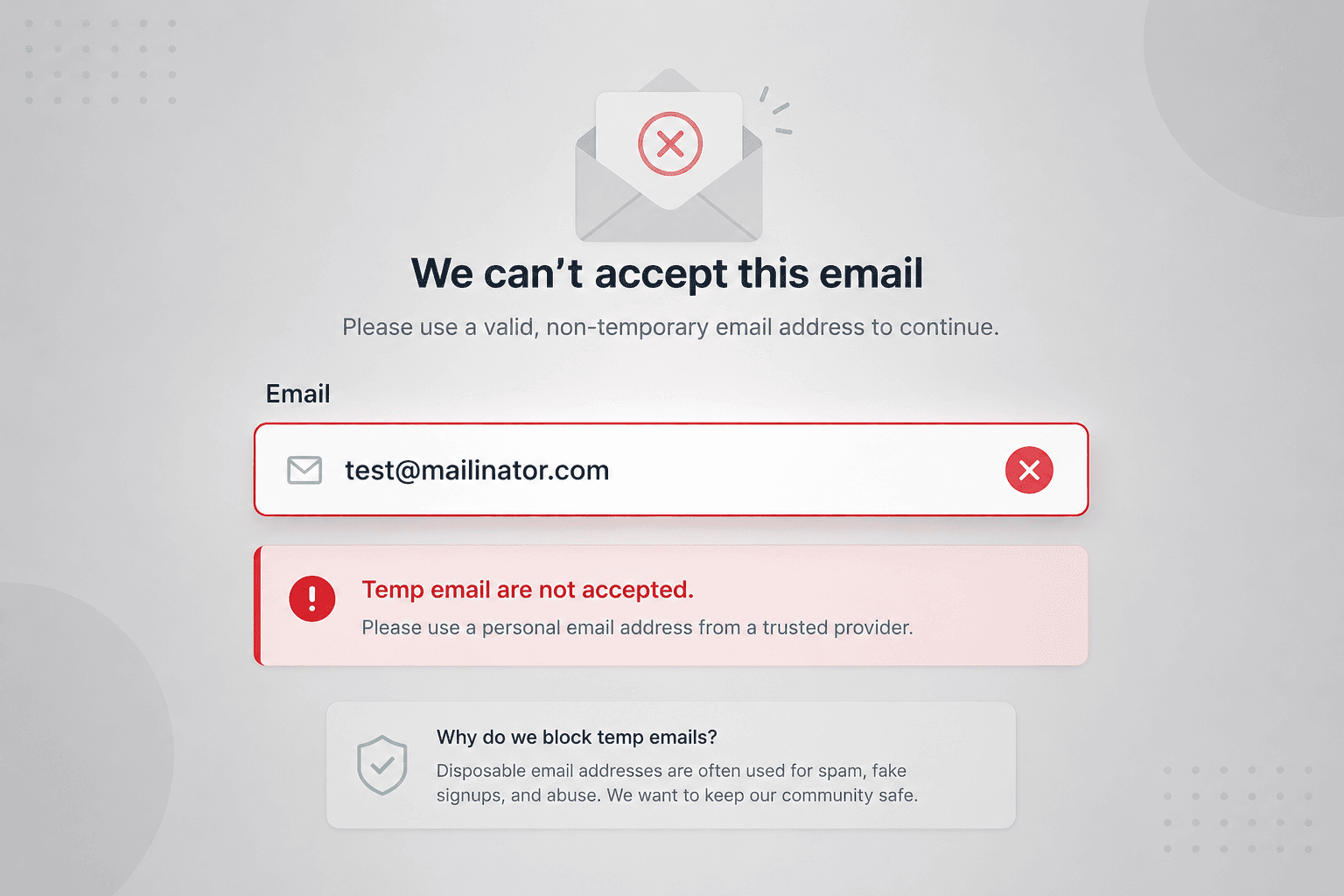
How to Block Disposable Emails at Signup (Free Temp Email Checker)
Stop throwaway signups before they bounce, burn free trials, and tank sender reputation. Use Reloop's free temp email checker — ~210k disposable domains, no SMTP probing.
How to Check if an Email is Disposable (Free Temp Email Checker)
In this guide, you'll learn what disposable emails are, why they matter, and how you can quickly check if an email is disposable.

Why Your Emails Land In Spam & How to Fix It
The definitive guide to diagnosing and fixing email spam folder placement — covering authentication, content, reputation, list hygiene, and ISP-specific issues.

Why We Open-Sourced Our Email Infrastructure
The story behind Reloop: why we built an open-source alternative to SendGrid, Resend, and Mailgun, why email infrastructure is too critical to rent forever, and what we're changing.
Ship your first email with Reloop in minutes
Open-source, deliverability-focused, and yours to self-host or run on Reloop Cloud. No lock-in, no rewrite later.