Best SparkPost Alternatives in 2026: Where to Go Now SparkPost Is Bird

Pranav Patel
Co-founder·12 min read
On this page
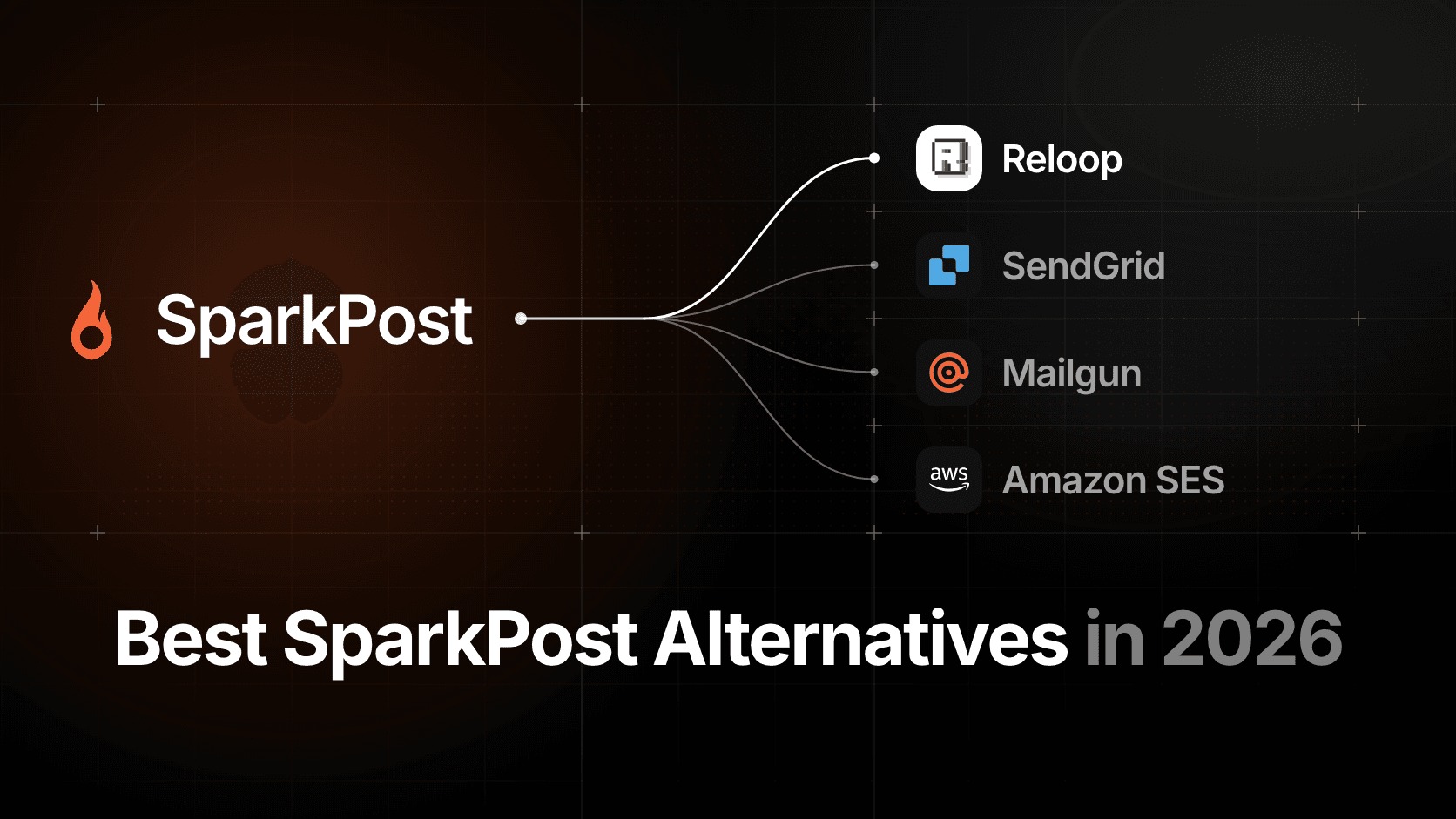
SparkPost is now Bird Email, so a migration is coming either way. The best SparkPost alternatives in 2026 compared: Reloop, Amazon SES, SendGrid, Mailgun, Postmark, Elastic Email and ZeptoMail on price, volume, inbound and migration.
The short version: SparkPost is now sold as Bird Email, and Bird says SparkPost requests may not work unchanged, so you're planning a migration whichever way you go. Under about 300,000 emails a month, Reloop is the cheapest complete platform: $10 for 50,000, a permanent free tier, inbound mailboxes and open source. At millions a month, Amazon SES (or Bird itself) wins on price per email.
We build Reloop, so weigh that. Every price below comes from the providers' public pricing pages, linked in our head-to-head posts, and each section says where that provider beats us.
What happened to SparkPost
- MessageBird agreed to acquire SparkPost and later rebranded as Bird.
- sparkpost.com now redirects to Bird's email product, and the old pricing page redirects to Bird's email pricing.
- Bird's own SparkPost page says Bird Email "has its own API and SDKs" and advises reviewing sending, templates, domains and webhooks "rather than assuming that a SparkPost request can be sent unchanged."
Bird Email is a real option, and we include it below. But since your sending layer needs work anyway, it's the right moment to compare.
Top picks at a glance
The comparison table
Bird's figures are usage at its Startup rate ($0.40 per 1,000) on a $15 monthly deposit. ZeptoMail's are based on its widely listed $2.50 per credit, which varies by region. Mailgun's 100k figure is its Scale plan ($90 for 100,000). SES figures are sending only.
1. Reloop: best overall SparkPost alternative
Reloop is open-source email infrastructure: a transactional API, SMTP relay, inbound mailboxes, contacts, campaigns, automations and webhooks in one product, hosted or on your own server.
Pricing: Free is 6,000 emails a month (200 a day). Pro is $10 for 50,000. Growth is $20 for 100,000 and includes a dedicated IP. Extra mail costs $0.50 per 1,000, and pay-as-you-go credits cost the same $0.50 per 1,000 and stay valid for 6 months. Self-hosting is free under Apache 2.0.
Why it fits SparkPost users
- Cheaper below about 300,000 a month. $10 vs about $20 on Bird at 50k, $20 vs about $40 at 100k. The two meet around 300k, and Bird gets cheaper above that.
- A dedicated IP for $20. On Bird it's a paid add-on from the Growth plan ($250 deposit).
- A simple send model. SparkPost's transmissions wrap content and a recipients list; Reloop is one flat request per message, with errors that return
message,whyandfix. - Inbound as real mailboxes you can read and reply to over the API, the MCP server or IMAP.
- No more forced migrations. It's open source, so if the vendor ever changes, you can run the same code yourself. Reloop Cloud runs on Hetzner, a German hosting company, with EU data centers.
Where SparkPost (Bird) is still ahead
- Price at high volume. Above 300k a month, Bird's $0.20–$0.45 per 1,000 beats Reloop's $0.50 overage.
- Analytics heritage and 30 days of message retention on every plan.
- SMS and WhatsApp in the same account. Reloop is email only.
Best for: SparkPost users sending under a few hundred thousand emails a month who want one platform for transactional, marketing and inbound mail.
Full breakdown: Reloop vs SparkPost
2. Amazon SES: cheapest at millions per month
Pricing: $0.10 per 1,000 emails plus $0.12 per GB of outbound data. Receiving costs $0.10 per 1,000. Dedicated IPs are $24.95 a month.
Strengths: the lowest list price by far, deep AWS integration, and huge scale. At 1,000,000 emails a month SES is about $100, against $470 on Reloop.
Weaknesses: no logs dashboard, template editor, bounce processing or campaigns. You build those with SNS, Lambda and storage, and new accounts start in a sandbox.
Best for: very high-volume senders, often former SparkPost customers, with engineers to build the tooling SparkPost gave them.
Full breakdown: Reloop vs Amazon SES
3. Bird Email: staying in the SparkPost family
If you'd rather stay, Bird Email is built on what Bird calls "the SparkPost engine, now one API."
Pricing: each paid plan adds a monthly deposit to a prepaid balance, charged per email. Free covers 1,000 emails a month (50 a day). Startup is a $15 deposit at $0.40 per 1,000, Growth a $250 deposit at $0.45, and Scale plans run from $0.35 down to $0.20 per 1,000.
Strengths: the SparkPost engine and analytics, 30-day retention on every plan, inbound included, and SMS and WhatsApp from the same vendor.
Weaknesses: a small free tier, a new API to migrate to anyway, and dedicated IPs only from Growth.
Best for: high-volume senders who want to keep the SparkPost engine and also need other channels.
4. SendGrid: best for enterprise contracts
Pricing: a 60-day trial at 100 emails a day. Essentials is $19.95 for 50,000 and $34.95 for 100,000. Pro, with a dedicated IP, subusers and SSO, starts at $89.95.
Strengths: proven at enormous volume, subusers and IP pools, Twilio procurement, and Handlebars logic in templates.
Weaknesses: no permanent free plan, marketing on a separate plan, an older API, and hosted only.
Best for: enterprises that want a large, established vendor with contracts to match.
Full breakdown: Reloop vs SendGrid · SendGrid alternatives
5. Mailgun: best for logs and inbound routing
Pricing: a 100-a-day free trial. Basic is $15 for 10,000. Foundation is $35 for 50,000, with overage from $1.30 per 1,000.
Strengths: detailed event logs and search, inbound routes that match and forward, and email validation as an add-on.
Weaknesses: expensive per email above the plan, dedicated IPs are extra, and campaigns are a separate Sinch product.
Best for: teams that relied on SparkPost's event data and want strong log search.
Full breakdown: Reloop vs Mailgun
6. Postmark: best for transactional deliverability
Pricing: a free developer plan of 100 emails a month. Basic is $15 for 10,000 with $1.80 per 1,000 overage; Pro and Platform lower that to $1.30 and $1.20. Dedicated IPs are $50 a month per IP above 300,000 a month.
Strengths: a strong transactional reputation and message streams that separate transactional from broadcast mail.
Weaknesses: the most expensive per email here at volume, and hosted only.
Best for: teams sending modest volumes where every receipt has to land fast.
Full breakdown: Reloop vs Postmark
7. Elastic Email: best low-cost bulk API
Pricing: the Email API's free plan is 3,000 emails a month (100 a day). Starter is $19 and Pro is $49, both for 50,000, and a volume slider runs up to 10 million a month. Dedicated IPs are a $40 or $50 add-on.
Strengths: may be cheap per email in the millions, and has a free plan of 3,000 emails a month.
Weaknesses: inbound and webhooks need Pro, logs are kept for 3 to 7 days, and marketing is a separate plan.
Best for: high-volume senders who want a hosted API without building on SES.
Full breakdown: Reloop vs Elastic Email · Elastic Email alternatives
8. ZeptoMail: cheapest prepaid credits
ZeptoMail, now part of Zoho CPaaS, sells transactional email as prepaid credits.
Pricing: one credit sends 10,000 emails, the first credit is free, and credits expire after 6 months. The price per credit is widely listed at $2.50 and varies by region.
Strengths: no monthly fee, cheap at mid-to-high volume (about $25 for 100,000), and WhatsApp and SMS from the same vendor.
Weaknesses: marketing email isn't allowed, there's no inbound mailbox, and credits expire.
Best for: strictly transactional senders who want pay-as-you-go pricing.
Full breakdown: Reloop vs ZeptoMail
How to choose
- "We send under 300,000 a month and want one platform." Reloop.
- "We send millions a month and have engineers." Amazon SES, or SES behind Reloop.
- "We want the SparkPost engine and other channels." Bird Email.
- "Enterprise procurement decides." SendGrid.
- "We only send transactional mail and want pay-as-you-go." ZeptoMail.
- "We never want a forced migration again." Reloop, the only open-source option here.
Migrating off SparkPost
- Verify your domain with the new provider. For Reloop, publish the
reloop._domainkeyDKIM record and mergeinclude:reloop.shinto your existing SPF record. Never publish a second SPF record. - Export your suppression list from SparkPost and import it before your first send.
- Rewrite the sending layer. Replace
transmissions.sendcalls with the new provider's client. In Reloop that's onereloop.mail.sendper message. - Move templates. SparkPost uses double-brace placeholders like
{{first_name}}; in Reloop they become{{{first_name}}}. - Point webhooks at a new handler. Reloop events like
email.deliveredandemail.bouncedare signed in theReloop-Signatureheader. - Ramp traffic from 10% to 100% over one to two weeks. If you send at high volume, warm a new dedicated IP gradually.
The SendGrid migration guide covers the same steps in detail, including a traffic-split flag and a suppression import script.
FAQ
SparkPost has become Bird Email. sparkpost.com redirects to Bird, and Bird says its email product has its own API and SDKs, so existing SparkPost code may need changes. Check Bird's pages for timelines that apply to your account.
It depends on volume. Under about 300,000 emails a month, Reloop is the cheapest complete platform ($10 for 50k, $20 for 100k). At millions a month, Amazon SES at $0.10 per 1,000 is cheapest if you build the tooling, and Bird's Scale plans go down to $0.20 per 1,000.
Reloop is open source under Apache 2.0 and runs its own MTA (KumoMTA). Use the hosted service or run the same code on your own servers.
Reloop receives mail into stored, threaded mailboxes you can read and reply to over the API, MCP or IMAP. Bird includes inbound with mailboxes too. SendGrid, Mailgun and Postmark post inbound mail to your webhook, and SES uses receipt rules.
Not if you migrate carefully: authenticate the new domain, import your suppressions, and ramp traffic gradually. Our SPF, DKIM and DMARC guide covers the DNS side.


Ship your first email with Reloop
in minutes.
Open-source, deliverability-focused, and yours to self-host or run on Reloop Cloud. No lock-in, no rewrite later.